
Alexander Graham Bell and Scotland
Alexander Graham Bell was born in Edinburgh on 3 March 1847. He is best known for inventing the telephone. Although he developed it after moving to North America, his early life in Scotland helped shape his interest in speech and sound. An inscription marks his birthplace on South Charlotte Street.
Bell grew up in a family that studied how people speak. His father, Alexander Melville Bell, taught speech and pronunciation. His grandfather also worked in this field. His father developed a system called “Visible Speech”. It used written symbols to show the positions of the mouth and tongue when making sounds. He intended it to help deaf people learn to speak. These subjects became an important part of Alexander Graham Bell’s own work.
Bell attended the Royal High School in Edinburgh. As a young man, he also worked at Weston House Academy in Elgin, where he taught music and speech while studying Latin and Greek. He spent a year at the University of Edinburgh in 1864–65. His education therefore included time in Edinburgh and northern Scotland.
Bell later lived in England. In 1870, he moved to Canada with his family. Both of his brothers had died from tuberculosis, and the family hoped that moving would protect the health of their surviving son. In 1871, Bell went to Boston to teach deaf students. He became a professor of vocal physiology and elocution at Boston University in 1873. His work concerned how the voice produces sound and how people speak.
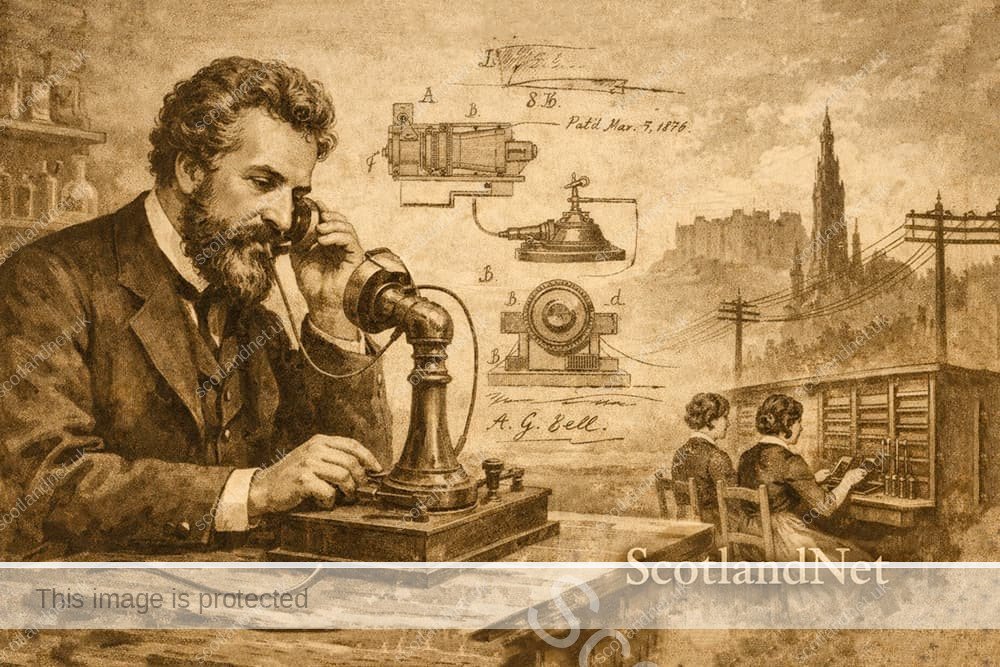
Bell worked with his assistant, Thomas Watson, to create a telephone that could send clear speech over a wire. Bell was granted a United States patent for his invention on March 7, 1876. Just a few days later, he proved it worked by talking to Watson using the new telephone.

Bell is known as the inventor of the telephone, but others like Antonio Meucci, Johann Philipp Reis, and Elisha Grey also played important roles.
The telephone was developed in North America. Scotland’s connection lies mainly in Bell’s birthplace, his education and the family work on speech that influenced him. Describing him as a Scottish-born inventor recognises this connection while also acknowledging the Canadian and American parts of his life.
Bell continued to work on other subjects, including sound recording, flight and boats. He spent part of each year at his estate, Beinn Bhreagh, near Baddeck in Nova Scotia. He died there on 2 August 1922, aged 75.
Bell’s association with Scotland went beyond being born there. His Scottish childhood, schooling and early teaching work gave him experience in the subjects that he later used in his research.
His career became international, but it began in Scotland.
Share this page.
