
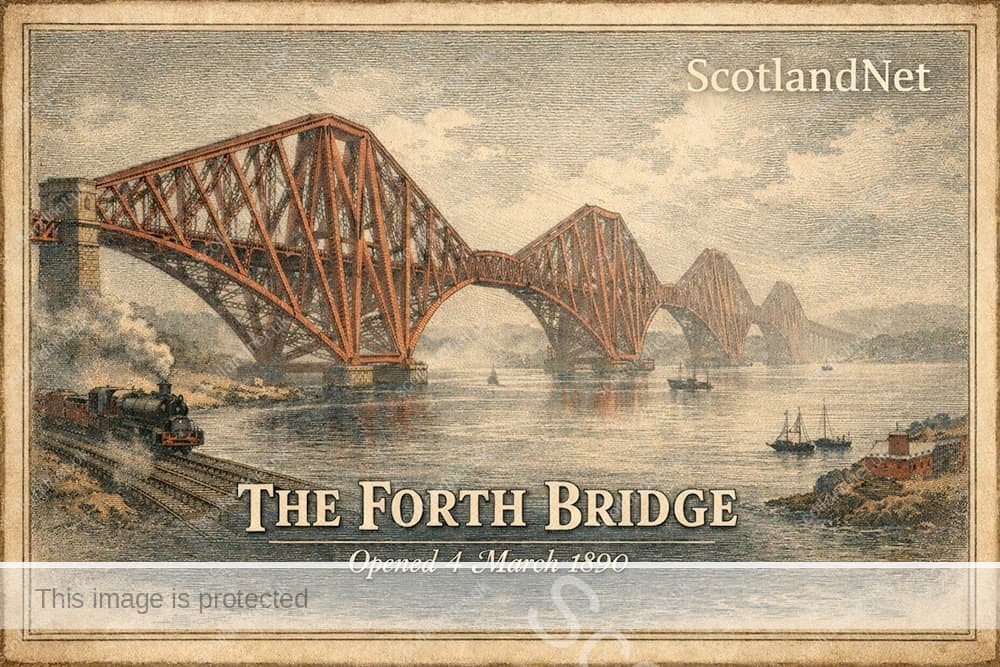
The Forth Bridge officially opened on 4 March 1890, by the Prince of Wales, who later became Edward VII, leading the ceremony. This event celebrated the end of one of the Victorian era’s most ambitious engineering projects.
Sir John Fowler and Sir Benjamin Baker designed the bridge, using huge steel cantilevers to cross the Firth of Forth and connect Edinburgh with Fife. When it opened, it was the world’s longest single cantilever span and soon became a symbol of industrial progress and careful engineering.
More than a hundred years later, the bridge is still in use and carries hundreds of trains every day. In 2015, it became a UNESCO World Heritage Site, showing its lasting importance around the world.
Further Reading
The Forth Bridges have linked Fife and Edinburgh since 1890, 1964, and 2017. This is the official website for the Forth Bridge, the Forth Road Bridge, and the Queensferry Crossing, Scotland’s famous three bridges spanning three centuries.
Over 400 photographs in the National Records of Scotland document the construction of the Forth Bridge. Taken by assistant engineer Evelyn Carey (1858-1932) during the bridge’s seven-year construction, the glass plate negatives provide a unique account of progress, from the construction of parts on drill roads to nearly completed spans.
The Three Bridges website explores the remarkable trio of crossings spanning the Firth of Forth near Queensferry: the historic Forth Bridge (1890), the Forth Road Bridge (1964), and the modern Queensferry Crossing (2017). Together, they illustrate more than a century of engineering innovation and form one of Scotland’s most striking coastal landmarks. The site explains the history, design, and construction of each bridge, showing how advances in engineering met the growing demand to link Edinburgh and Fife. Visitors will also find photographs, videos, and guidance on viewpoints and nearby attractions, making the website a useful introduction to the heritage and scale of this famous Scottish skyline.