
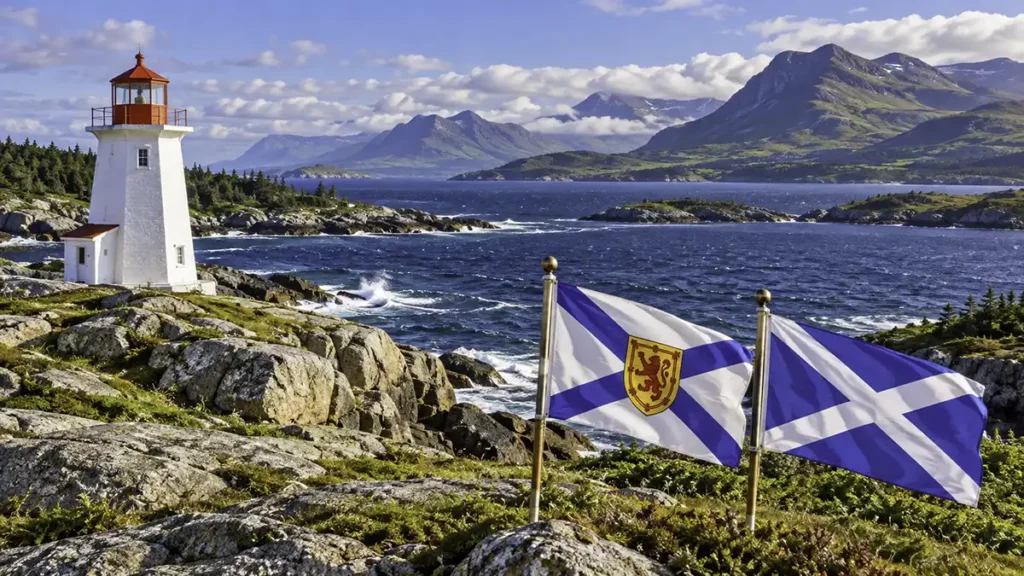
Nova Scotia is a province on Canada’s Atlantic coast. Its capital is Halifax. The province includes a mainland peninsula and Cape Breton Island. Its name means “New Scotland” in Latin, and its connection with Scotland goes back more than 400 years.
The Mi’kmaq had lived there for thousands of years before Europeans arrived. Nova Scotia is part of their traditional territory, known as Mi’kma’ki.
Why it is called New Scotland
In 1621, King James VI of Scotland, also James I of England, granted Sir William Alexander a royal charter to establish a Scottish colony in North America. The proposed colony was called Nova Scotia. The charter covered a territory much larger than the province is today.
In 1629, about 70 Scottish settlers arrived at the site of present-day Annapolis Royal. They built Charles Fort and supported themselves through farming, fishing and trade with the Mi’kmaq.
The settlement lasted only three years. In 1632, a peace treaty returned the territory to France, and most of the Scottish settlers returned to Great Britain. Although this early colony was short-lived, the name Nova Scotia survived.
Scottish immigration
The larger, longer-lasting Scottish settlement came in the late 1700s and the first half of the 1800s.
One of the best-known events was the arrival of the ship Hector at Pictou in 1773. It carried settlers from Scotland and became an important part of Nova Scotia’s Scottish immigration story.
Looking for a better life, more immigrants came from Scotland’s Highlands and islands. Others faced poverty or were forced from their homes during the Highland Clearances, when landlords removed tenants from their land.
Scottish immigrants settled in areas including Pictou, Antigonish and Cape Breton. Families often followed relatives or neighbours who had already moved. This helped communities keep their language, religious traditions and links with particular parts of Scotland.

The Gaelic language
Many Highland settlers spoke Scottish Gaelic. For some, it was their only language. They brought it into their homes, churches and communities in Nova Scotia.
Gaelic also appeared in songs, stories, and poetry. Parents and grandparents passed these traditions to younger generations, often by speaking and singing rather than through books.
The language declined as English became dominant in schools and workplaces. Even so, some Nova Scotian families continued to pass it down.
Today, community groups and the provincial government support Gaelic learning and cultural activities. Nova Scotia’s Gaelic Affairs office works to help the language and its traditions reach future generations.
Music and community traditions
Scottish settlers brought fiddle music, songs, dancing and storytelling. These traditions became part of local life, especially in Cape Breton.
The ceilidh was an important way to share them. A ceilidh is a social gathering where people may tell stories, sing, play music and dance. In Nova Scotia, these gatherings helped keep Gaelic culture alive.
The traditions also developed in their new surroundings. Nova Scotian musicians and singers preserved material from Scotland while adding their own work and local experiences. Cultural exchanges have since brought some of these traditions back to Scotland.
The Scottish connection in the flag
Nova Scotia’s flag shows its Scottish origins. It has a blue diagonal cross on a white background. This reverses the colours of Scotland’s flag, which has a white diagonal cross on blue.
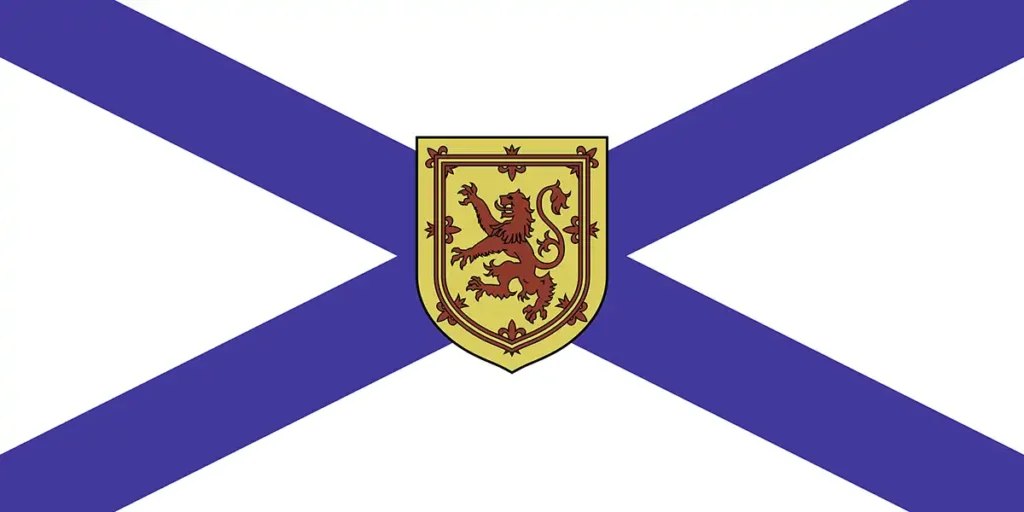
At the centre is a shield showing Scotland’s red lion on a gold background. These symbols come from Nova Scotia’s historic coat of arms, granted in 1625.
Nova Scotia’s connection with Scotland continues through family ancestry, Gaelic language, music and community traditions. These links are part of the province’s wider history, alongside its Mi’kmaq heritage and the histories of its other communities.
Share this page.