
A Complex Chapter in Scotland’s History
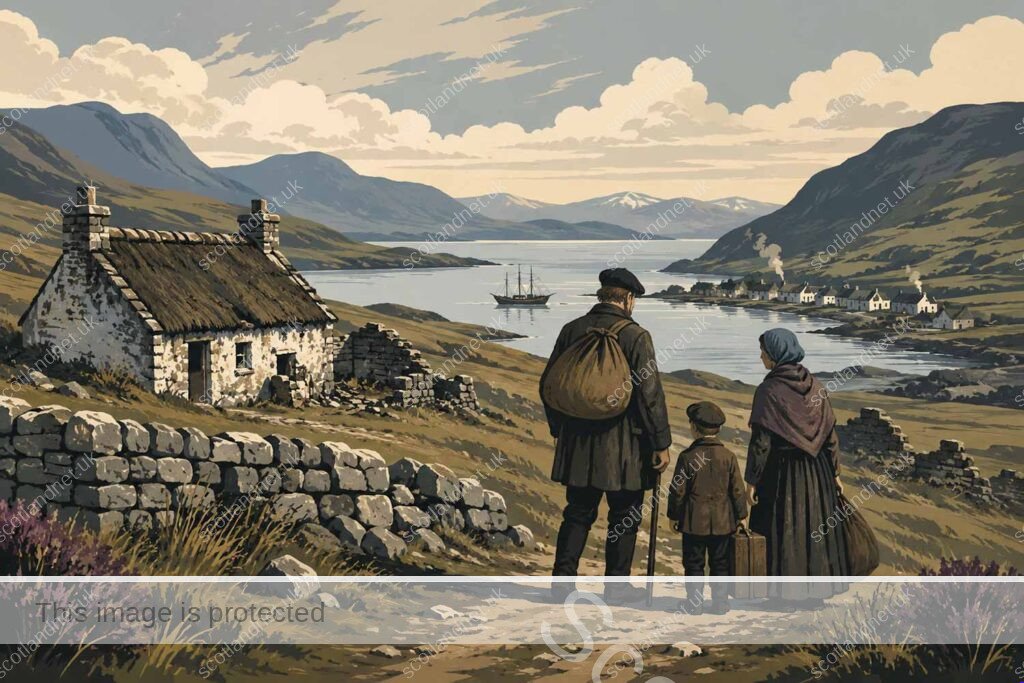
Few events in Scottish history stir up stronger feelings than the Highland Clearances.
From the late 1700s to the mid-1800s, thousands of Highland families left or were forced to leave their homes, which changed the Highlands for good. Villages vanished, Gaelic communities faded, and many Scots started new lives abroad, helping to create the Scottish diaspora we know today.
For many, especially those whose ancestors moved to North America, Australia, or New Zealand, the Clearances stand for injustice and loss. Family stories have been shared for generations and are often echoed in books, movies, and TV shows. While these stories are based on real experiences, historians now see the Highland Clearances as much more complicated than just a fight between harsh landlords and powerless tenants.
To understand the Clearances, we need to look at the big economic and social changes happening in Scotland and much of Europe during that period.
The End of the Clan System
For centuries, Highland society was built around the clan. Chiefs were not just landowners. They were expected to protect their people, settle arguments, and lead. In return, clan members gave loyalty, military service, and rent.
After the Battle of Culloden in 1746, government actions weakened the old clan system. In the years that followed, many chiefs gradually shifted from leaders to owners of commercial estates.
Some estates were deeply in debt, and trends among the Scottish upper class led to costly lifestyles. Managing estates became more about balancing the books than keeping traditional communities together.
Why Did the Clearances Happen?
There was no single cause.
In the 1700s, the Highland population grew a lot. Many small farms could no longer support larger families. At the same time, better farming methods and the booming wool trade made large sheep farms much more profitable than the old townships.
Across Britain, landowners began adopting new farming methods. Bigger, more efficient farms yield higher profits, and many thought the old ways no longer made economic sense.
These pressures were felt across rural Britain. Similar changes were taking place elsewhere in Britain.
In England, for example, the Enclosure Movement saw land that had traditionally been farmed by local communities divided into privately owned fields. While these reforms often improved agricultural productivity, they also displaced many rural families and transformed the countryside.
Wales saw rural depopulation, and similar changes occurred in Ireland and across Europe.
The Highland Clearances were part of this bigger shift, but they hit Highland society especially hard because of the unique clan system.
Who Was Responsible?
One of the most persistent myths is that the Clearances were imposed solely by English landlords.
The historical facts show a more complicated story.
Many of the estates involved were owned by Highland Scots themselves. Chiefs from well-known clans like the Sutherlands, MacLeods, MacDonalds, Campbells, Gordons, and MacKenzies made changes on their own lands. The estate managers, lawyers, and officials who carried out these policies were often Scottish too.
Some estates were later bought by wealthy landowners from other parts of Britain, but no single nationality was to blame. Most of the time, economic reasons were behind these changes, not ethnicity.
Knowing this does not take away from the suffering of those who lost their homes. Many hard choices were made within Scottish society itself.
How the Clearances Worked
The Clearances did not happen the same way everywhere.
Some tenants were simply told their leases would not be renewed. Others were encouraged to move on their own. In many areas, families were moved from inland glens to new crofting communities on the coast, where they were expected to add to their farming by fishing, harvesting kelp, or weaving.
Some landlords invested in building harbours, schools, and planned villages, hoping to create stronger communities. Others gave financial help to people moving overseas.
In other places, the process was much harsher. Houses were torn down or had their roofs removed so people could not return, and some evictions were known for their cruelty. These events are still regarded as among the darkest times in Highland history.
One community’s experience could be very different from another’s, even if they were only a few miles apart.
The Human Cost
No matter what individual landlords intended, the social effects were huge.
Old settlements vanished. Families who had lived on the same land for generations were scattered. The Gaelic language faded as communities broke apart, and it became harder to keep traditional songs, stories, and customs alive.
Many families who moved struggled to survive on poor coastal land, and not all government or estate plans worked out. Poverty was still common in many crofting areas.
The emotional pain of leaving ancestral homes has endured for generations and continues to shape how people remember the Clearances today.
New Lives Overseas
Even though emigration often came from hardship, many Highland families eventually built successful lives in other countries.
Scottish emigrants set up communities in Canada, the United States, Australia, New Zealand, and South Africa. They became farmers, engineers, teachers, soldiers, politicians, and business owners, bringing parts of Highland culture with them as they settled into new places.
Today, millions of people worldwide have ancestors who left the Highlands during the Clearances.
The story isn’t just about losing homes—it’s also about surviving hard times and starting over in pastures new.
How Historians See the Clearances Now
Most historians today agree that the story of the Clearances is anything but straightforward.
They generally agree that:
- Some landlords tried to help and looked for fair solutions.
- Others cared mostly about making money and didn’t think much about the people living on their land.
- Money problems were real and often very serious at the time.
- Sometimes there were other options, but they weren’t always used.
- Each estate was different, so it’s hard to make one simple statement about them all.
The Highland Clearances cannot be seen as just one event or policy. Instead, they were a long and varied process that took place over many decades, shaped by changes in economics, politics, and society.
Highland Clearances – Legacy
The Highland Clearances changed the land, hastened the end of the old clan way of life and prompted many Scots to move abroad and start new lives far from home.
Today, ruined cottages, empty villages, and memorials can be found across the Highlands as reminders of this time of great change. They encourage us to think not just about what was lost, but also about the strength of those who rebuilt their lives elsewhere.
The story of the Highland Clearances is not just about progress or tragedy. It is a story of big human change, with hardship, opportunity, tough choices, and lasting effects. This story still shapes Scotland and millions of people around the world who are proud of their Scottish roots.
Categories
- Accommodation (1)
- Arts & Culture (14)
- Civic Life & Public Services (8)
- Food & Drink (1)
- History & Heritage (13)
- Landscape & Environment (9)
- Media & Broadcasting (6)
- Questions (10)
- Scottish Diaspora (3)
- Sport & Leisure (14)
- Travel (8)
- Visitor Guides (4)
Share this page.