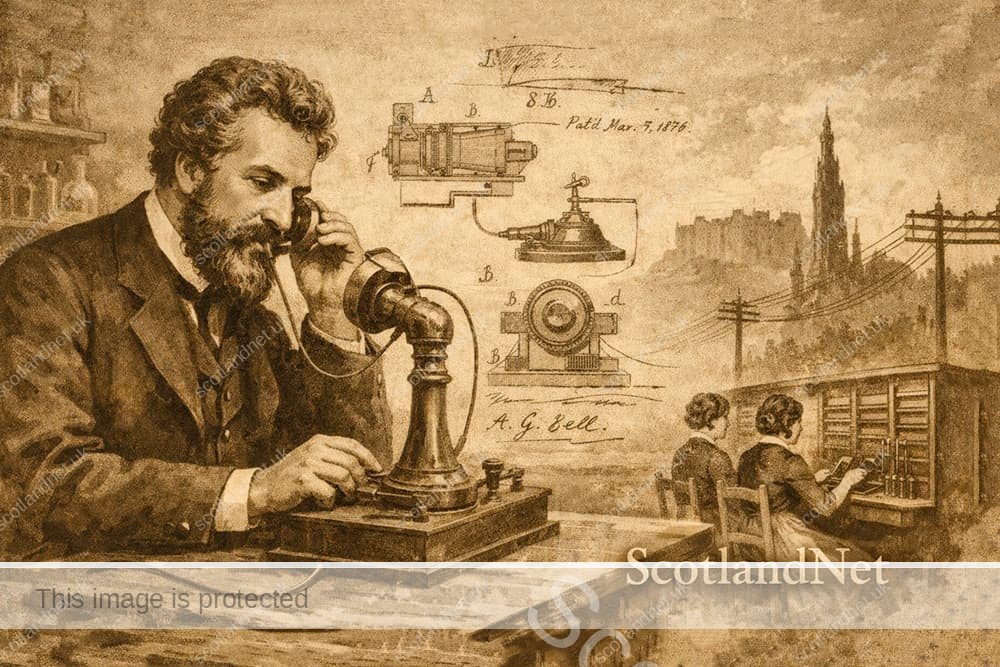
Alexander Graham Bell is one of the most influential Scots in global communication. While many know him for inventing the telephone in North America, his early years in Scotland shaped his thinking. Growing up in a family focused on speech and elocution, Bell’s story is about more than technology; it’s about language, sound, and a lifelong drive to connect people.
Edinburgh Roots
Alexander Graham Bell was born on 3 March 1847 at 14 South Charlotte Street in Edinburgh. His father, Alexander Melville Bell, was a well-known expert on elocution and created “Visible Speech,” a way to teach pronunciation to the deaf. Bell’s grandfather also worked in elocution. So, Bell grew up in a home where speech was studied both scientifically and in everyday life.
Bell attended the Royal High School of Edinburgh, though he did not finish in the usual way. From a young age, he was curious about sound and how things worked. As a boy, he tried out ideas with acoustics and built simple devices to solve real problems. These experiments were part of his family’s goal to better understand and improve human speech.
The Bell family later moved to London, but Scotland remained foundational in forming his intellectual outlook. It was here that he first absorbed the idea that sound could be broken down, studied, transmitted—and perhaps one day reproduced.
From Speech to Electricity
In 1870, following the deaths of his two brothers from tuberculosis, Bell moved with his parents to Canada. He later went to the United States and taught deaf students in Boston. At this time, his main focus was on communication and teaching speech, not electrical engineering. Multiple telegraph messages simultaneously over one wire led him toward a breakthrough. By 1876, he had secured a patent for what he described as “an improvement in telegraphy.”
Mr Watson, come here, I want to see you.
On 10 March 1876, he famously transmitted the words: “Mr Watson, come here, I want to see you.”
Those words marked the beginning of the telephone.
Even though historians still discuss other inventors and patent arguments, Bell’s patent became the starting point for today’s telecommunications industry. The success of the Bell Telephone Company and the growth of large communication networks began with that achievement.
The Telephone and Its Impact.
The first telephones were basic, with fragile transmitters, short range, and uneven sound quality. Still, within a few decades, cities in Britain, North America, and other places were linked by wires that carried voices instead of coded signals.
In Scotland, the telephone changed business, journalism, and everyday life. Cities like Glasgow and Edinburgh set up exchanges that sped up business communication. The Highlands and Islands joined the national networks later, helping to overcome their isolation.
Bell did more than invent a device—he changed how people thought about distance. Now, speech could travel as fast as electricity. Business moved faster. News spread quickly. Families who had moved apart could stay in touch. The change in how people felt about distance was just as important as the technology itself.
A Wider Scientific Mind
Although most people remember Bell for the telephone, his interests went much further. He did experiments in flight, working on tetrahedral kites and early ideas that led to powered flight. He also invented the “photophone,” which sent sound using light beams. This idea came almost a hundred years before fibre-optic communication.
Bell was always dedicated to education for the deaf. His wife, Mabel Hubbard Bell, had been deaf since she was a child, and both his work and personal life stayed closely connected to speech therapy and communication research.
Bell eventually settled in Nova Scotia, Canada, where he died in 1922. As a tribute, telephone services across North America stopped briefly during his funeral.
A Scottish Legacy
Even though Bell became a North American citizen and businessman, Scotland still sees him as one of its most important figures. His birthplace in Edinburgh is marked, and his legacy is part of Scotland’s long tradition of innovation, alongside people like James Watt and John Logie Baird.
Bell shows a unique Scottish tradition of combining strong scientific interest with practical results. His work came not just from engineering ambition, but from a culture that valued education, speech, and progress.
Bell’s story highlights a common theme in Scottish history: making a global impact from local roots. A boy in Edinburgh interested in sound helped lay the foundation for modern communication.
Why Bell Still Matters
Today, with smartphones and worldwide data networks, the first telephone seems old-fashioned. Still, every phone call, video chat, and digital message owes something to Bell’s first idea: that sound could be turned into electricity and sent somewhere else.
Now, with fibre optics, satellites, and mobile broadband, Bell’s work looks less like a strange invention from the past and more like the start of a continuing communications revolution.
Bell’s legacy is not just about technology, it’s about people. The telephone brought people, businesses, and countries closer together. It changed how we communicate in diplomacy, journalism, and family life. From South Charlotte Street in Edinburgh to global telecommunications networks, Alexander Graham Bell’s life shows how Scottish curiosity and innovation can last for centuries.
Table of Contents

Categories
- Aberdeenshire
- Arts & Culture
- Community
- Education & Learning
- Environment
- Ephemera
- Football
- Glasgow
- Golf
- Government & Civic Life
- Groups and Clubs
- Healthcare & Wellbeing
- Historic Figures
- History & Heritage
- Islands & Coastlines
- Landscape & Environment
- Literature
- Media
- Museums & Collections
- Music
- Music & Song
- Nature & Wildlife
- Night Sky & Astronomy
- Public Services
- Questions
- Rivers, Lochs & Waterways
- Rugby
- Scottish Highlands
- Sport
- Theatre & Performance
- Travel
- Vintage Postcards
- Visitor Guides
- Visual Arts
- Volunteer & Emergency Services
- Walking Routes & Trails